
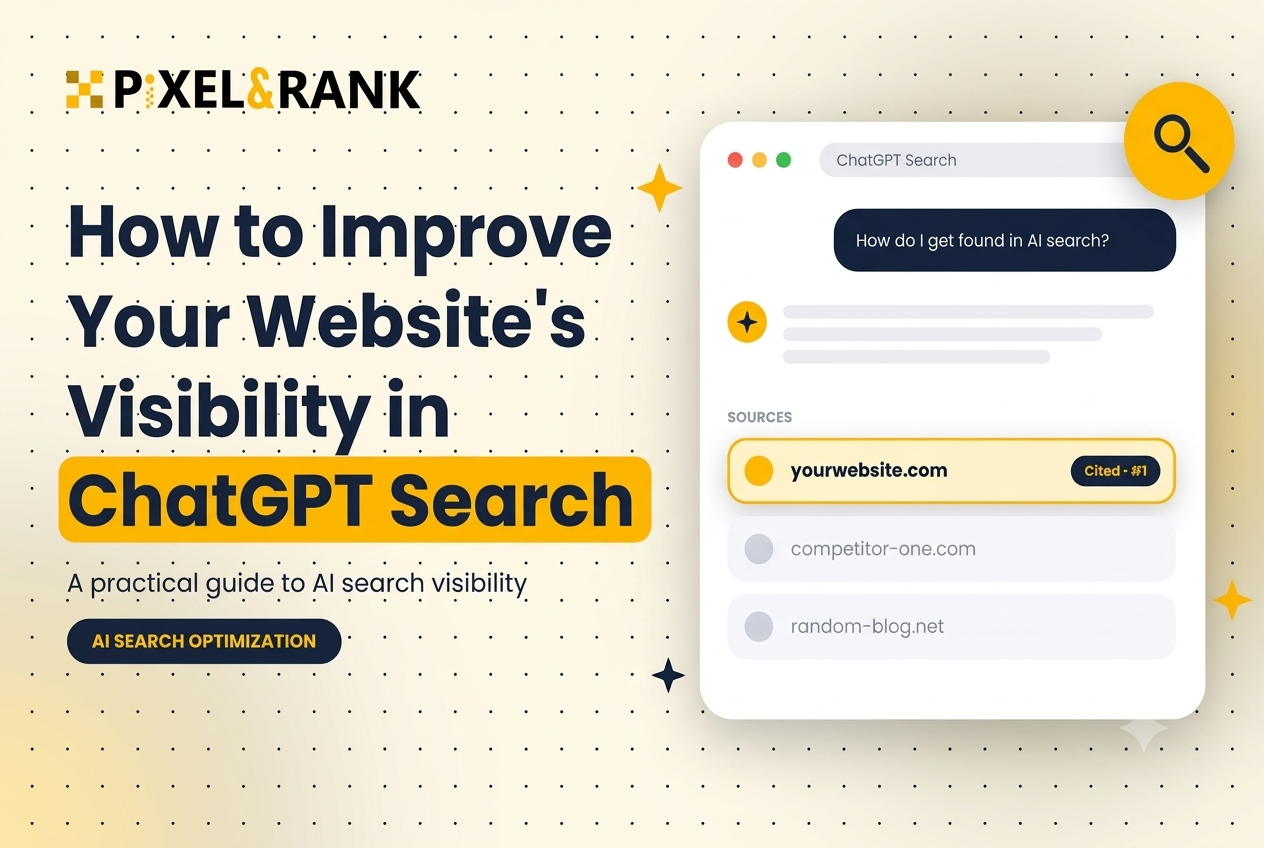
Search behaviour is changing. People are increasingly using AI tools to ask questions, compare businesses, research products, and find solutions without browsing through dozens of web pages. For businesses, this creates a new opportunity to reach potential customers through ChatGPT Search.
But how can you make your website easier for ChatGPT to discover? Is traditional SEO still important? And what can you do to help your brand appear in relevant AI-generated answers?
The answer starts with a strong SEO foundation. Helpful content, accessible web pages, reliable information, and a credible online presence can all support your website’s discoverability.
In this guide, we’ll explore practical ways to improve your visibility in ChatGPT Search, explain how the process works, and show how businesses can build a strategy that supports long-term organic growth.
What Is ChatGPT SEO?
ChatGPT SEO refers to the process of improving a website’s chances of being discovered, cited, or linked in ChatGPT’s search experiences.
Unlike a traditional search engine results page, which commonly displays a list of web pages, ChatGPT Search can provide a conversational answer with links to relevant sources. Users can ask follow-up questions, explore recommendations, and research a topic in greater detail.
For example, someone might ask, “Which SEO agency can help a small business improve its local search visibility?”
A response may include relevant information about SEO services and links to websites that help answer the question. Businesses with useful, accessible, and relevant information have an opportunity to be discovered through this process.
The purpose of ChatGPT search optimization is not to manipulate AI responses. It is to make your website a useful, credible source that search systems can access and understand.
It’s also important to set realistic expectations. No optimization technique guarantees a mention or a particular position in ChatGPT Search. The results can vary depending on the question and the information available.
How Does ChatGPT Find Websites?
Understanding how ChatGPT finds websites helps explain where businesses should focus their efforts.
ChatGPT Search can use web search providers and automated crawling to help find relevant information. OpenAI operates a crawler called OAI-SearchBot, which helps discover and surface websites in ChatGPT search results.
When someone asks a question, the system can retrieve relevant sources and use them to help generate a response. Relevant links may then appear alongside the answer.
This means that ChatGPT website indexing is not simply a matter of submitting a URL and expecting it to appear. Your site needs to be accessible to the relevant discovery systems, and its content needs to be useful for the questions people ask.
For example, a digital marketing agency publishing a detailed guide on local SEO may have a better opportunity to contribute useful information to a local marketing question than a page containing only a list of services.
The objective is to help search systems discover your pages and understand why they are relevant.
7 Ways to Improve Website Visibility in ChatGPT Search
1. Make Sure ChatGPT Can Crawl Your Website
Before improving your content, check whether the relevant crawler can access it.
One of the first steps in how to appear in ChatGPT search results is reviewing your website’s technical accessibility.
OpenAI recommends allowing OAI-SearchBot to access the pages you want to be discoverable in ChatGPT Search. Your robots.txt file, hosting provider, or content delivery network may affect access.
For example, a website might have excellent service pages but unintentionally block the search crawler through a restrictive robots.txt rule.
Review the following:
- Check whether OAI-SearchBot is blocked in robots.txt.
- Confirm that your hosting provider or CDN allows the crawler’s published IP addresses.
- Make sure important pages return the correct HTTP status codes.
- Remove accidental noindex directives from pages you want discovered.
- Maintain a clear internal linking structure and XML sitemap.
If your business wants its pages to appear in ChatGPT Search, these checks are a sensible starting point.
Important: OAI-SearchBot and GPTBot serve different purposes. OAI-SearchBot is associated with search discovery, while GPTBot relates to potential model training. Website owners can manage these crawler permissions separately.
Official reference: OpenAI’s overview of its web crawlers.
2. Publish Content That Answers Real Questions
People often use ChatGPT to ask complete questions rather than enter short keyword phrases.
Your content should reflect the way customers naturally seek information.
A business selling accounting services, for example, could publish helpful articles answering questions such as:
- How much does accounting support cost for a small business?
- When should a company hire an accountant?
- What documents are needed for tax preparation?
- How can businesses simplify their bookkeeping?
Each article should answer the main question clearly before exploring supporting details.
This is a practical way to optimize content for ChatGPT. It also makes the content more helpful to people visiting your website directly.
Avoid creating dozens of near-identical articles just to target slight variations of the same phrase. Instead, provide original explanations, useful examples, and information that demonstrates genuine experience.
A strong content strategy answers questions thoroughly rather than simply repeating keywords.
3. Build a Clear and Logical Website Structure
Your website should make it easy for people and search systems to understand what each page covers.
Use descriptive page titles, meaningful H2 and H3 headings, concise paragraphs, and internal links that connect related topics.
For example, an SEO agency might have a main SEO services page linking to separate pages about technical SEO, local SEO, keyword research, and content marketing.
A supporting blog post about local SEO could then link back to the relevant service page.
This structure helps visitors navigate your website and gives search systems additional context about the relationship between your pages.
When planning website optimization for AI search, make sure important information is available as readable text rather than being hidden exclusively inside images, inaccessible scripts, or interactive elements.
Structured data can also help describe certain types of content when implemented correctly. However, no special schema markup guarantees that ChatGPT will cite your website.
4. Build Brand Credibility Beyond Your Website
Your website is only one part of your online presence. Relevant mentions, professional profiles, industry publications, customer reviews, and credible references can help people understand your business.
Imagine two agencies offering similar SEO services. One has a clear website, detailed case studies, consistent business information, and genuine industry contributions. The other has a basic website with little supporting information.
The first agency gives prospective customers more evidence to evaluate its experience and services.
To strengthen your online reputation:
- Keep your business name, services, and contact information accurate.
- Maintain relevant business listings and professional profiles.
- Publish genuine case studies that explain your work and results.
- Contribute useful insights to reputable industry websites.
- Encourage honest customer reviews without incentives that violate platform policies.
- Earn relevant links and mentions by sharing original research or practical expertise.
These activities support AI search optimization by helping establish a more consistent and credible brand presence.
However, brand mentions alone do not guarantee visibility. Focus on genuine authority and relevance rather than attempting to manufacture mentions solely to influence AI responses.
5. Make Your Website a Credible Source
Being accessible is important, but credibility matters too. A page should offer information that readers can understand, evaluate, and trust.
When making factual claims, cite reliable sources. Where appropriate, include the author’s experience, publication dates, original data, and examples from actual projects.
For example, if you publish an article about improving organic traffic, explain which changes were made, the period measured, and the results observed. Avoid presenting a single case study as proof that the same outcome is guaranteed for every business.
Use ChatGPT content optimization as an opportunity to improve clarity and usefulness, not to make content sound artificially authoritative.
Keep information accurate and updated when facts change. If you use AI tools to help create content, review the final draft carefully and add genuine expertise rather than publishing generic material without meaningful editing.
Google’s guidance on helpful, reliable, people-first content is a useful reference for these principles.
6. Continue Investing in Traditional SEO
A common misconception is that businesses need an entirely different strategy for AI search. In reality, traditional SEO remains an important foundation.
Google explains that its own AI search features continue to rely on established SEO fundamentals, including technical accessibility and helpful content. ChatGPT Search has its own systems, so the exact factors are not identical, but maintaining strong SEO practices remains worthwhile.
When reviewing ChatGPT search ranking factors, remember that OpenAI does not publish a complete formula that guarantees placement.
Focus on the areas you can control:
- Conduct keyword research based on customer needs.
- Improve page titles, headings, and on-page content.
- Resolve crawling and indexing issues.
- Strengthen relevant internal links.
- Improve mobile usability and page performance.
- Publish original, well-researched content.
- Monitor organic search performance and conversions.
A sustainable ChatGPT SEO strategy builds on these fundamentals instead of relying on unverified ranking tricks.
7. Track ChatGPT Referrals and Improve Over Time
Optimization should be measured, not based entirely on assumptions.
If your website receives visits from ChatGPT Search, you can examine the traffic in an analytics platform such as Google Analytics.
OpenAI states that ChatGPT referral URLs include the UTM parameter utm_source=chatgpt.com, which can help website owners identify this traffic in their analytics reports.
Review:
- Referral sessions originating from ChatGPT.
- Landing pages receiving those visits.
- Engagement and conversion activity.
- Enquiries or sales associated with referral sessions.
- Changes in the visibility of your brand for relevant questions.
Tracking ChatGPT referral traffic helps you understand whether these visits are contributing to business goals.
You can also manually test a consistent set of relevant questions and record whether your business appears in the answers. Treat this as a directional check, not a definitive ranking report, because responses can change between searches.
Over time, these insights can help you refine your content and increase website traffic from ChatGPT where relevant opportunities exist.
What Is Generative Engine Optimization (GEO)?
Generative engine optimization (GEO) is a term used for efforts to improve the likelihood that content or a brand will be referenced in AI-generated responses.
It overlaps with traditional SEO through its focus on useful information, technical accessibility, relevance, and credibility.
For businesses, the practical approach is straightforward: make important pages accessible, answer customer questions clearly, demonstrate real expertise, and build a trustworthy online presence.
There is no reliable shortcut that guarantees a brand mention. Be cautious of services promising fixed ChatGPT rankings or guaranteed citations without explaining a measurable, evidence-based process.
Improve Your AI Search Visibility With Pixel & Rank
Making your website discoverable in ChatGPT Search requires more than adding a few AI-related keywords. It involves building a technically accessible website, publishing genuinely helpful content, demonstrating expertise, and maintaining a credible online presence.
At Pixel & Rank, we can help you identify technical SEO issues, strengthen your content strategy, improve your website structure, and develop a practical plan for emerging AI search experiences.
Whether you’re starting from scratch or looking to improve an established website, the first step is understanding what is working and where opportunities remain.